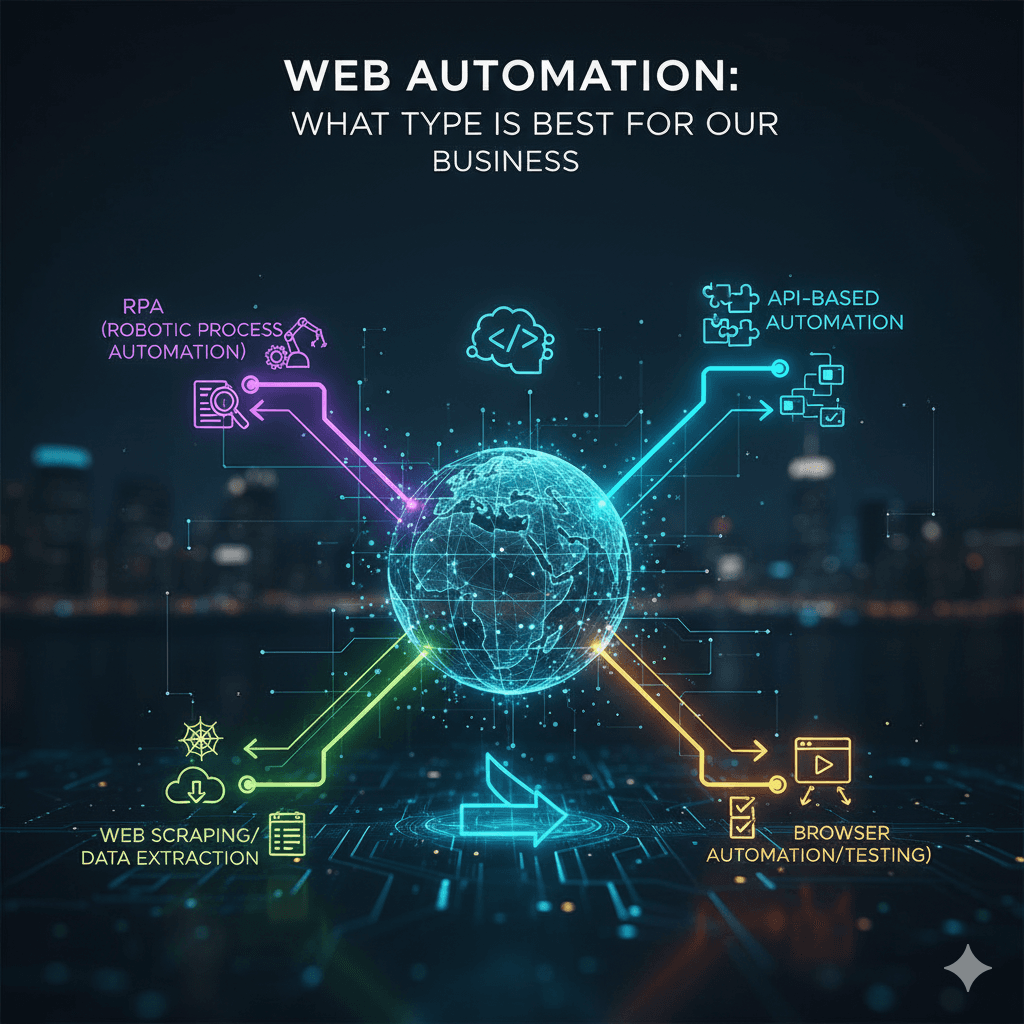
Web Automation Types RPA, API-Based, Web Scraping, and Browser Automation
When businesses start thinking about automation, they usually begin with the same question:
Should we use a no-code automation platform, or should we build private, open-source AI agents?
It feels like a simple choice, but the right answer depends entirely on your use case, your data, and the scale of your operations.
If you are a business owner, this guide will help you understand the difference so you can make the right decision for your company.
what is a no-code automation platform?
Tools like n8n and Lovable allow you to build simple automations using boxes and arrows. You do not write code. You click and drag steps to create a small workflow.
these tools are useful when:
- You are a small, one-person business
- You want to automate something simple
- The data is not sensitive
- You do not need high accuracy
- The volume of work is small
For example:
- Moving a weekly report into Google Sheets
- Sending a notification when a web form is filled
- Copying a simple data point from one system to another
For small tasks, these tools can work.
But this is where most businesses fall into the trap.
No-code tools look easy at first, but they do not scale. And they are not designed for serious business processing.
open-source AI agents: what they are and why they matter
Open-source agents are different.
You download the AI models. You download the automation tools. You run everything inside your own network or inside your own private cloud.
Your data never leaves your environment. Your financial information and commercial secrets never go to OpenAI, Google, Anthropic, or any outside system.
these private agents can:
- Read documents
- Understand data
- Make decisions
- Follow rules
- Handle exceptions
- Connect with your systems
- Process thousands of tasks
- Operate at scale with accuracy
They are built for real business automation not just simple tasks.
why the first decision must always be: use case and context
Before choosing any automation approach, you must understand two things:
1. what is the real job the automation must perform?
Is it one invoice per day, or one thousand per day? Is it a simple data copy, or a complex decision-making process?
2. how accurate does the process need to be?
If you run a company, anything involving finance, HR, sales operations, compliance, or customer data must be right every time.
no-code tools struggle with anything beyond basic workflows.
They break when:
- The input data varies
- The process has many exceptions
- The decisions are complex
- The scale increases
- Accuracy is essential
- Edge cases appear
And every business has edge cases.
a simple example: why scale changes everything
Imagine you want to automate invoice processing.
if you only process one or two invoices a week:
A no-code tool might work.
but if you process hundreds or thousands each month:
You need a system that can:
- Understand different invoice layouts
- Check supplier information
- Apply the right tax logic
- Match purchase orders
- Handle duplicates or missing data
- Manage exceptions
- Escalate problems
- Learn from mistakes
No-code tools cannot do this. Private agents can.
data integrity: the most important factor most business owners overlook
This is the single biggest risk with no-code automation tools.
Most no-code platforms work by connecting your systems to external services. Many require direct API connections to public AI providers like OpenAI or Google.
when you send data to those external AI platforms, you are handing over:
- Your customer information
- Your financial records
- Your contract data
- Your pricing strategy
- Your intellectual property
These companies may store your data, train on your data, and use it to improve their models.
Most business owners have no idea this is happening.
For any SME or mid-sized company that handles sensitive data, this is not acceptable.
with private, open-source agents:
- The data never leaves your network
- It never goes to an external AI company
- There is no risk of exposure or data leakage
edge cases: the silent killer of no-code automation
Businesses do not run on perfect data. There are always exceptions.
for example:
- An invoice arrives with missing details
- A supplier uses a different template
- A purchase order number does not match
- A customer form is incomplete
- A sales record is out of sequence
No-code tools usually fail when they hit an edge case.
- They cannot make decisions
- They cannot adapt
- They cannot understand context
private AI agents can:
- Read, understand, and decide what to do
- Route exceptions to humans
- Learn from feedback
This is why real automation requires agents not just workflows.
why serious operations should avoid no-code for core processes
No-code tools are useful for hobby projects and micro-business tasks.
But if you run a real business with staff, customers, suppliers, and operations you need more.
here is why open-source agents are the better choice:
1. data security
- Your data stays inside your environment
- No external AI company receives it
- No risk of leakage or training extraction
2. accuracy
- Agents can make decisions based on rules
- They can be tested and quality-controlled
- They improve with reinforcement learning
3. scale
- Agents can process thousands of tasks
- No-code tools collapse under high volume
4. flexibility
- Agents handle messy, real-world data
- Different formats, different templates, different conditions
5. control
- You own the system
- You can tune it, monitor it, improve it, and expand it
For any growing company, this matters more than convenience.
a good rule for business owners
Here is the simplest way to decide:
if the task is simple and low-risk:
No-code might be fine.
if the task is core to your operations:
- Involves money
- Involves customers
- Involves compliance
- Involves sensitive data
- Or needs high accuracy
You need private, open-source agents.
It is that simple.
what to be careful of
you should be concerned if:
- Someone suggests building mission-critical automations in no-code
- A team member wants to push your finance data into a public AI
- A vendor uses OpenAI or Google directly for invoice processing
- You cannot control where the data goes
- The automation has no ability to handle edge cases
These are red flags. They lead to errors, security risks, data loss, and compliance issues.
final thoughts
Automation is powerful but only when it is done correctly.
No-code tools have their place, especially for simple, one-off tasks or for solo operators.
But for SMEs and growing companies that care about accuracy, scale, and data protection, the right choice is almost always private, open-source agents.
they:
- Protect your data
- Scale with your business
- Handle real-world complexity
- Give you full control
- Deliver real operational automation
This is the path that brings long-term value and long-term safety to your business.
ready to build the right automation for your business?
Find out which automation approach is right for your operations.
Start with a free 15-minute intro call