
Timeline showing shift from in-house teams to VAs to AI agents
The End of the VA Era: Pivoting from Virtual Assistants to Agentic AI
Over the last decade, outsourcing repetitive work to offshore Virtual Assistants was the smartest operational move a digital business could make. Labour arbitrage cut marginal costs, freed founders from the grind, and unlocked growth. But that was the previous generation’s play. The next industrial shift is already underway, and it makes the VA model feel glacial by comparison. The same businesses that once outsourced to humans are now replacing entire VA workflows with hyper-efficient, autonomous AI agents.
TL;DR
- First wave: Shift work from expensive in-house teams to offshore VAs and benefit from labour arbitrage.
- Second (current) wave: Replace delegation with automation—agentic AI executes the workflow end-to-end.
- Cost gap: AI agents are at least 80% cheaper to operate than even the best offshore VA.
- Drivers: Falling compute costs, soaring accuracy, and always-on consistency.
- Action: Use platforms like ProcessZero.ai to encode VA SOPs into agents, so you manage systems, not people.
The Inherent Friction of the VA Model
Offloading work to VAs was brilliant—until you tally the hidden friction:
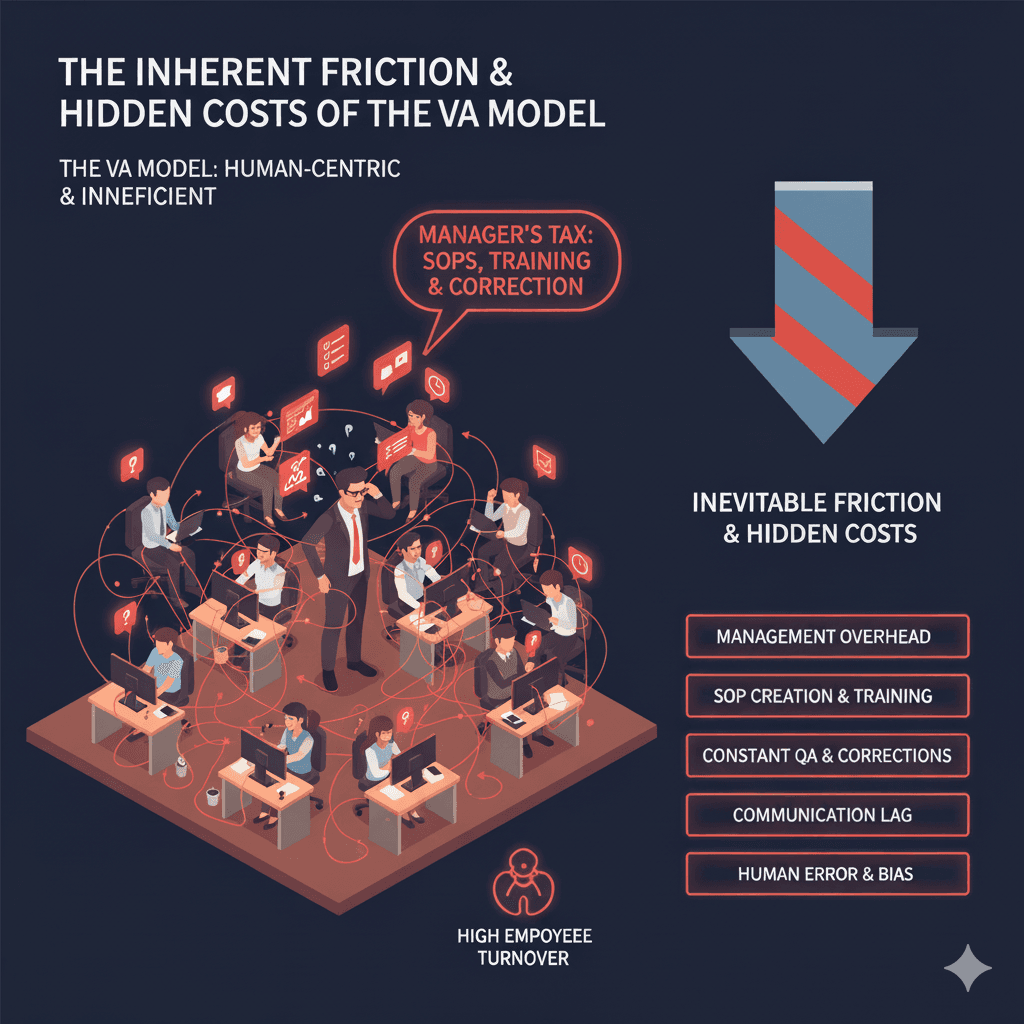
- Manager’s tax: You become the full-time manager—documenting SOPs, filming walkthroughs, monitoring Slack/WhatsApp, and double-checking every output.
- 24-hour lag: Time-zone gaps turn a five-minute clarification into a 24-hour delay, slowing launches and compounding mistakes.
- Security risks: VAs often require “keys to the kingdom”—logins for stores, banks, and CRMs—creating ongoing compliance headaches.
- Linear scaling: Every growth spurt means sourcing, hiring, onboarding, and training more humans. Productivity only scales linearly.
- Quality ceiling: Humans have good and bad days. Fatigue, distraction, and turnover make consistent excellence nearly impossible.
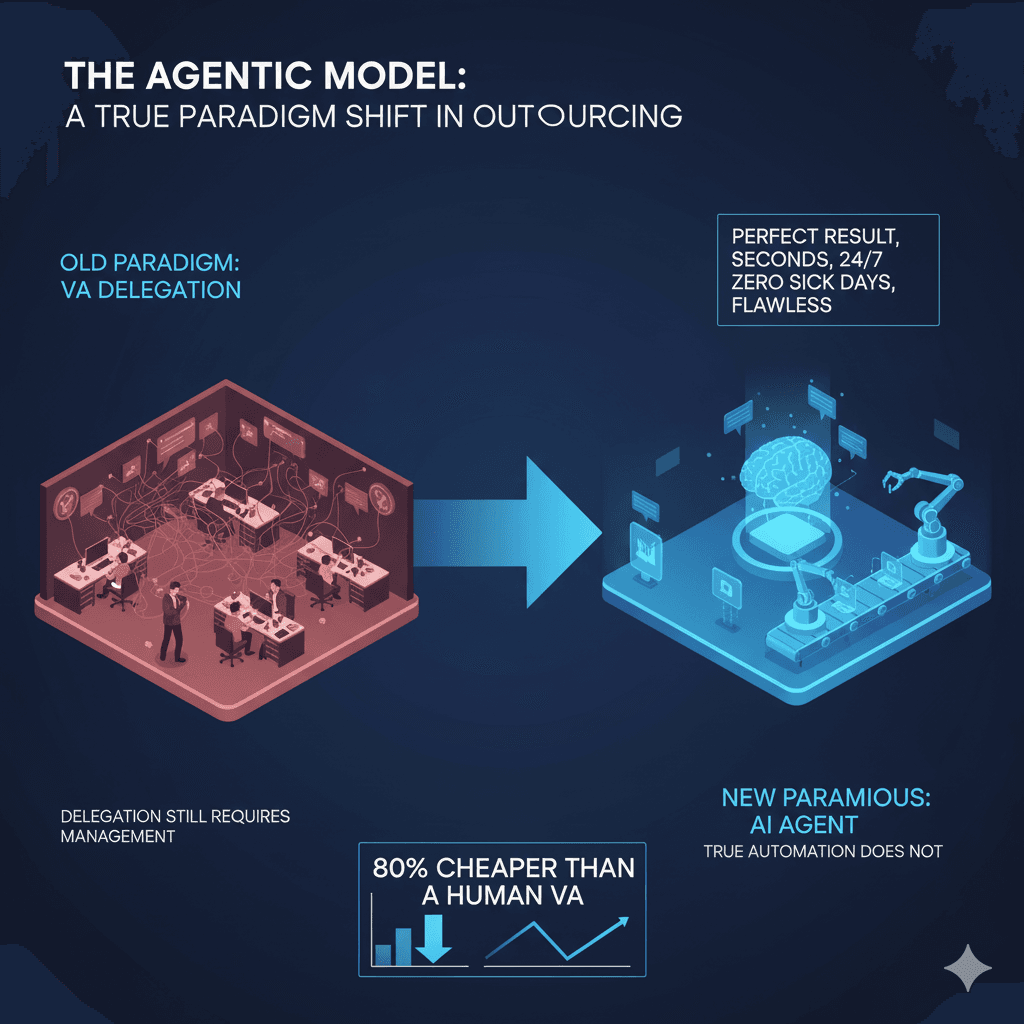
Diagram highlighting manager overhead in VA workflows
Enter the Agentic Model
Agentic AI replaces the delegation paradigm with true automation. You don’t assign tasks to a person; you assign them to an autonomous system that runs the entire SOP automatically.
- 80% lower operating cost. This isn’t just cheaper than a domestic employee—it’s dramatically cheaper than a highly optimized offshore VA.
- Perfect execution. Agents never drift from the SOP, never misinterpret, and never pause. Their consistency removes downstream rework costs.
- Infinite scale. Add capacity instantly without recruiting or onboarding. One agent can handle the workload of an entire team.
- Security-first. Agents work through controlled APIs and scoped credentials, slashing the risk of shared passwords and unauthorized access.
Graphic showing AI agent executing VA tasks autonomously
How to Make the Pivot
- Inventory the work. List every task currently done by VAs—order management, catalog updates, marketplace compliance, supplier follow-ups, executive inbox triage.
- Prioritize high-frequency SOPs. Focus on processes that run daily or weekly and have clear rules or decision trees.
- Encode in an agent platform. Use ProcessZero.ai to map the data inputs, decision logic, and actions an agent should perform.
- Pilot, measure, scale. Launch with one workflow, capture the hours saved and error rates eliminated, then roll the blueprint across departments.
From Managing People to Managing Systems
The agentic shift is inevitable because the economics are overwhelming. You stop paying to manage humans and start operating a fleet of precision-tuned systems. The founders and operators who led the first VA wave now have the clearest path to lead again—by building AI agents that run their business with zero managerial drag.
If you’ve already embraced outsourcing, you’ve shown the courage to change how work gets done. The next leap is to replace the very workflows you outsourced with software that never asks for a sick day, never misses a handoff, and never exposes your systems. That’s how you build a business that’s lighter, faster, and more profitable than anything competing on manual labour alone.
Comments (0)
Leave a Comment
